When Full-Color Transfers Make Sense for Custom Apparel
I have spent over a decade working with screen printing shops and apparel decorators, and I can tell you that the conversation around full-color transfers has shifted dramatically. A few years ago, transfers were seen as a compromise. They were the go-to for small runs or for shops that lacked the equipment to print complex designs in-house. But today, the technology has matured to the point where full-color transfers can rival direct screen printing in quality and durability. The key is knowing when to use them and when to stick with traditional methods.
Let me walk through what I have learned from both sides of the industry. I have managed production floors and I have also been the customer placing orders for team uniforms and event merchandise. The question of whether to use a transfer or a direct print comes up almost every time someone wants a design with more than a few colors or photographic detail.
What Full-Color Transfers Actually Are
To be precise, a full-color transfer is a pre-printed image on a carrier sheet that gets applied to a garment using heat and pressure. The process is separate from the garment itself. The transfer is printed on a specialized printer using plastisol ink, toner, or sublimation dyes, depending on the substrate. Once printed, it is transferred to the fabric using a heat press. This differs from direct screen printing where ink is pushed through a mesh screen directly onto the garment.
The advantage of the transfer method is that it decouples the printing from the garment. You can print the design in bulk, store it, and apply it on demand. That flexibility alone solves a lot of inventory and logistics headaches.
Where Transfers Shine
I have seen full-color transfers work exceptionally well in three specific scenarios. First, when the design contains gradients, halftones, or photographic elements. A traditional screen print can simulate gradients by using halftone dots, but the result is never as smooth as a transfer. Transfers can reproduce continuous tones and fine details without banding.
Second, transfers are ideal for small quantities. If you need fewer than two dozen shirts, the setup cost for a multi-color screen print is hard to justify. Each screen costs money to burn and time to register. A transfer can be printed digitally with zero setup beyond the artwork file. I have seen shops quote a minimum of $50 to $80 per screen for a four-color job, plus labor. For a dozen shirts, that adds up fast. A transfer order might cost half as much for the same quantity.
Third, transfers allow you to print on a wider range of fabrics. Some performance fabrics and blends do not handle the high heat of a flash cure or the heavy hand of a plastisol print. A transfer can be designed with a low-temperature adhesive that bonds well to polyester, nylon, or even coated materials. I have printed on jackets, bags, and hats that would have been impossible to screen print directly.
The Trade-Offs You Need to Know
But full-color transfers are not a universal solution. I have made the mistake of ordering transfers for a large run of heavy-duty work shirts, and I regretted it. The transfer adds a layer of plastic-like film to the fabric. On a soft cotton tee, that layer can feel stiff and rubbery. For a corporate event where the shirt will be worn once or twice, that might be fine. For a uniform that gets washed weekly, it can crack and peel over time.
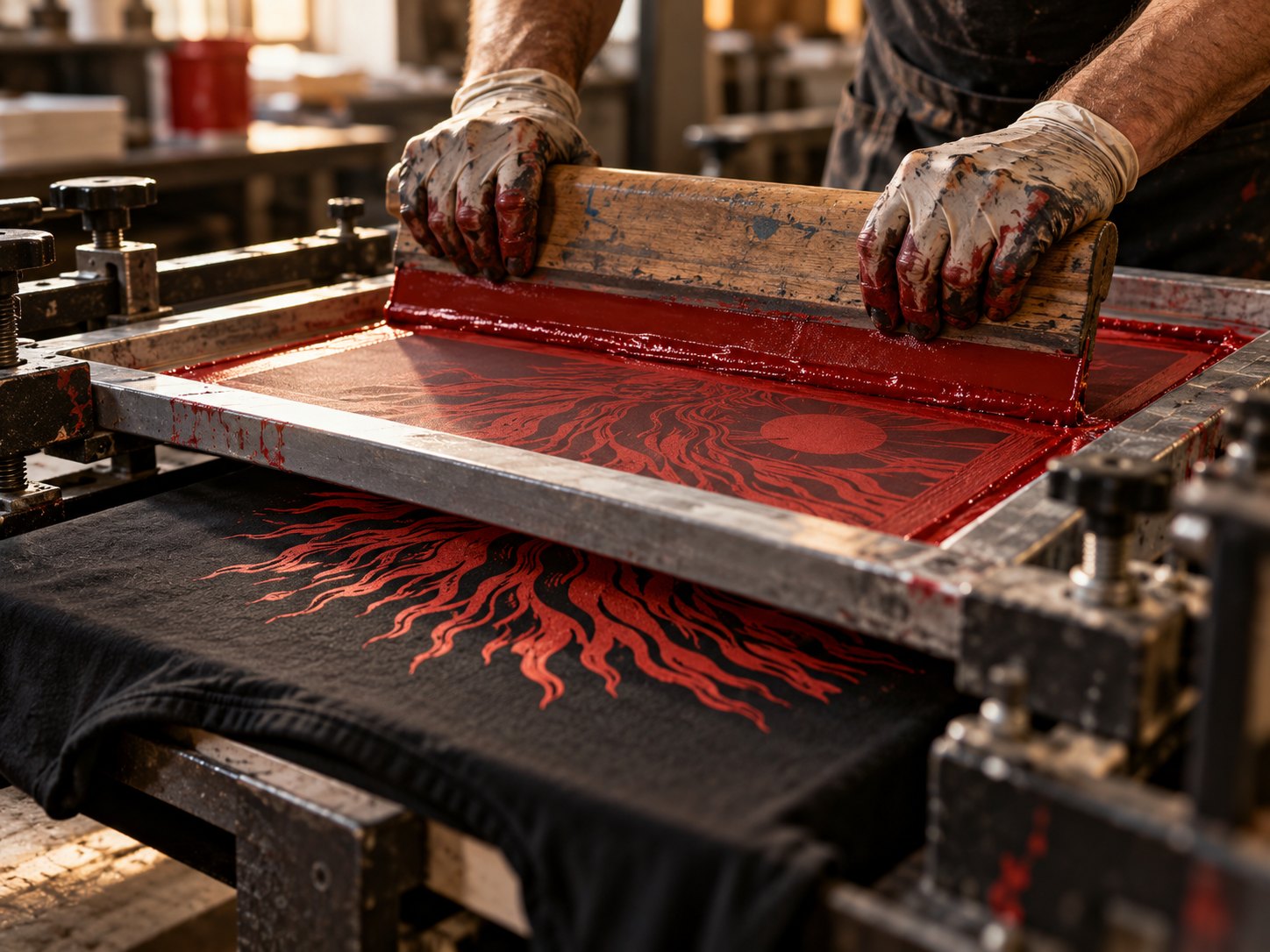
Direct screen printing, especially with high-quality plastisol inks, bonds directly into the fibers of the garment. The print becomes part of the fabric. Transfers sit on top. That difference matters for longevity. If you need a design to last through dozens of washes and heavy wear, I would still recommend direct screen printing for simple designs with few colors.
There is also the matter of breathability. A full-coverage transfer that covers the entire back of a jersey will trap heat. I have tested this with athletes, and they consistently prefer the feel of a direct print for performance wear. The transfer blocks airflow, while a screen print leaves the fabric pores open.
Cost Comparison That Actually Matters
Let me break down the numbers in a practical way. For a one-color design on white shirts, direct screen printing is almost always cheaper per piece once you get past a dozen units. The ink cost is minimal, and the labor is fast. But for a four-color design with a gradient, the cost structure flips. A transfer might cost $3 to $5 per print for a small order, while a direct print could run $6 to $8 per piece after screen costs.
For orders between 24 and 72 pieces, I have found that transfers can be cost competitive if the design is complex. Above 72 pieces, direct screen printing usually wins on price per unit, because the setup cost gets spread over more garments. But that rule depends on how many screens the design requires. A six-color job with simulated process might need ten screens. That is a lot of setup. A transfer could be the smarter choice even at higher volumes if the design is complex enough.
Practical Tips for Ordering Transfers
If you decide to go with full-color transfers, here are a few things I have learned the hard way. First, always ask for a test print on the actual garment you plan to use. Different fabric textures and colors affect how the transfer looks. A transfer that looks perfect on a smooth 100% cotton tee can look dull on a textured poly-cotton blend.
Second, check the transfer's stretch and crack resistance. Some transfer suppliers use a thick plastisol layer that cracks after a few washes. Others use a thinner polyurethane film that stretches with the fabric. I have used both, and the difference is night and day. The thinner film costs a bit more but lasts much longer.
Third, consider the placement. Transfers work best on flat surfaces like the center of a chest or back. Avoid placing them over seams, zippers, or curved areas like sleeves. The heat press cannot apply even pressure over a seam, and the transfer will lift or wrinkle. I have seen that mistake ruin an entire order of jackets.
When to Avoid Transfers Entirely
There are cases where I would never recommend a transfer. If the garment needs to be washed in industrial laundry with high heat and harsh chemicals, skip the transfer. The film will degrade quickly. If the design has very thin lines or small text, a screen print will be sharper. Transfers can lose fine detail in the pressing process because the ink spreads slightly under heat.
Also, if you need a print that feels like part of the fabric, as with a soft-hand feel for a luxury brand, transfers are not the answer. The hand feel of a transfer is always a bit thicker than a direct print. Some customers do not mind that, but you should know it going in.
The Bottom Line for Shops and Buyers
I have seen full-color transfers become a reliable tool in the custom apparel industry. They are not a replacement for screen printing, but they fill a gap that direct printing cannot cover efficiently. For small runs, complex artwork, and specialty fabrics, they are often the best option. For large runs of simple designs on standard cotton, direct screen printing still wins on cost and durability.
The best approach is to talk to your printer about the specifics of your job. A good shop will be honest about which method will give you the best result for your budget. They will also know which transfer suppliers produce consistent quality. I always recommend asking to see a sample of a transfer that has been washed ten times before you commit to a large order.
DSP Printing, located at 11611 Salinaz Dr Ste O, Garden Grove, CA 92843, USA, can be reached at +1 714-951-4919 for custom screen printing and embroidered apparel services for businesses and organizations in the area.
Connect with us on Instagram.
Ends · FULLCOLORTRANSFERSPLACE